
Before you start: source checks and account risks#
Roblox script provenance is the trail connecting a loader, its hosted files, and the account publishing them. We fetch loaders as text and never run them, so a status is not proof a script works. Your aim is a dated source record: who published the address, what it returned, and where the trail stops.
Before you start: keep the original listing URL, the complete loader text, a plain-text viewer, and a place to record observations. Read remote files as text. Do not paste unfamiliar code into an execution environment, install a download offered as verification, or provide account credentials to inspect a source.
Using third-party scripts through executors to exploit Roblox breaks the Roblox Terms of Use and can result in account bans. Text-only screening cannot establish runtime behavior or remove that account risk. Roblox’s Cheating and Exploiting guidance warns about account deletion and exploit-related malware. The Community Standards support page directs readers to the relocated standards, whose cheating section prohibits using or sharing exploits for unfair advantage.
The Roblox Terms of Use provide the broader platform agreement. Source checks do not create an exception to those rules. redzhub.dev is an independent index, not the Redz Hub developers’ site. The Redz Hub example below follows our 26 October 2026 check. Start with the loader’s address, then follow the files it points to.
How to verify a Roblox script without executing it#
Roblox script verification starts with reading the loader, tracing its destinations, checking the publisher’s evidence, and recording the limits of inspection. Work through the eight steps in order. Keep the listing’s promises beside your observations so you can compare them without confusing the two.
1. What does the loader actually fetch?#
A remote loader identifies an entry point, which may fetch additional files. Read the whole line or block, identify the URL passed into the HTTP fetch, and distinguish the request for text from the instruction that would run it. A short loader is not necessarily a short program.
The Redz Hub README publishes a global loader targeting https://raw.githubusercontent.com/tlredz/Scripts/refs/heads/main/main.luau. Our 26 October 2026 fetch returned that target as text: HTTP 200, 3,106 bytes, readable. Reading main.luau revealed game routing and additional downloads; inspecting only the README line would miss those dependencies.
Checkpoint: record the exact entry URL, its owner and path, and every destination visible in the fetched text. Mark computed or unreadable destinations unresolved. Keep settings separate from the source address so a configuration difference is not mistaken for a different publisher.
Common mistake: assuming a familiar one-line pattern establishes authorship. Compare the destination character for character with the publisher’s README. Check the owner as carefully as the filename; a familiar path under a different account is a different source.
2. Identify the host and the final destination#
The host tells you where the file lives. Publisher identity needs a separate check. Separate the website displaying a loader from the domain receiving its request, and distinguish a repository page from a raw file response.
| Host pattern | Record during inspection | Verification boundary |
|---|---|---|
| GitHub raw | Owner, repository, reference, file path | Hosting identifies a repository location, not the person behind the account |
| Pastebin | Exact paste address, visible author, linked source | A pasted copy needs independent attribution |
| Pastefy | Exact paste address, visible author, linked source | A matching title does not connect the paste to a developer |
| Custom domain | Full hostname, path, redirects, publisher links | A brand-shaped domain is not evidence of maintainer control |
| Luarmor | Visible service address and publisher reference | A protected response can leave the underlying code uninspectable |
Use these host patterns as a checklist when reading a listing. The worked example here covers Redz Hub’s GitHub files; it does not verify individual Pastebin, Pastefy, custom-domain, or Luarmor listings. For each source you inspect, write down the visible address and publisher links before drawing a conclusion.
Checkpoint: preserve both the starting URL and any final response URL. Inspect redirects as evidence of a changed destination; do not treat a redirect to an unrelated page as recovered source code. Stop at an access barrier rather than trying to defeat it.
Common mistake: treating the listing domain as the code host. Give the listing URL and code URL their own fields. The remote loader explanation shows how those layers connect. Once you have the destination, check the publishing account.

3. Does the GitHub account establish the publisher?#
A GitHub handle identifies the account publishing the repository. Connecting that account to a particular developer takes supporting evidence, such as matching publisher links. Record the exact handle, account creation date, repository creation date, profile links, and README references. Treat the account’s biography as a statement by that account.
Our 26 October 2026 check identifies tlredz/Scripts as the current upstream repository. The account and repository were created on 30 May 2025. The profile names the Discord nickname real_redz; that nickname is identity evidence to compare, not independent proof of ownership of earlier accounts.
The GitHub API returned HTTP 404 for REDzHUB, realredz, and newredz on 26 October 2026. Similar names and the README suggest a possible lineage, but the relationship between those older accounts and tlredz remains unverified. Do not rewrite that uncertainty as a confirmed account migration.
Checkpoint: write separate conclusions for the current repository and historical identity. An account’s age can provide context, but no minimum age proves authorship. Record an unavailable creation date as unknown rather than guessing from the earliest visible commit.
Common mistake: using a familiar nickname as a complete chain of custody. Name the connection you cannot verify. The Redz Hub source record keeps that identity question separate from the next question: what the repository history shows.
4. Inspect commit history and the licence#
Repository history shows visible changes and their dates. A licence addresses reuse permission, so check it separately from the code history. Inspect changes to the loader and fetched game files rather than relying exclusively on commit titles or the repository’s latest push timestamp.
At our 26 October 2026 check, tlredz/Scripts showed ten visible commits dated 20–23 October 2026 and a last push of 23 October 2026 at 17:29 UTC. One commit message was “update obfuscation.” History before 20 October was not visible; the reason is unknown. The account creation date therefore must not be presented as the start of the visible development history.
The repository had no licence file at that check. redzhub.dev records the README-published loader’s copy-paste publication as its basis for displaying that loader, with attribution. Displaying that published loader does not establish permission to republish the full repository. Keep author attribution, reuse permission, and behavioral review as separate fields.
Checkpoint: record the visible history range, relevant file changes, and licence finding. Preserve a commit identifier when available so another reader can inspect the same revision. If you cannot find a revision identifier, leave that field unknown and keep the exact URL and date instead.
Common mistake: interpreting a recent push as a complete release or treating public visibility as permission for unrestricted reuse. Name the changed file and record any stated reuse terms. Next, compare the shared loader directly with the README example, including its settings.
5. Compare the README and spot look-alike repositories#
A loader matches a README only when the source address and relevant configuration agree with that README’s published example. Compare owner, repository, reference, and filename before evaluating surrounding promises. A familiar repository name or copied description can conceal a different destination.
Our check found newredzv3/Scripts, whose account was created on 12 March 2026 and repository on 19 March 2026. Its 3,012-byte main.luau was structurally near-identical to tlredz’s loader but added routes for VoxSeas.luau and Grow-a-garden.luau. The relationship to the Redz developer was unverified, and redzhub.dev did not offer it as copyable.
Structural similarity supports a comparison of files; it does not establish permission, shared ownership, or malicious intent. Describe a GitHub fork relationship only when evidence shows one. A look-alike repository can be discussed as a separate repository without calling it a fork or accusing its publisher of impersonation.
Checkpoint: make a short difference record: changed owner, changed paths, added routing, changed settings, and missing attribution. If the candidate introduces a game absent from the compared loader, record that added route as a difference rather than proof of a newer release.
Common mistake: interpreting a longer game list as evidence of succession. Look for a publisher link confirming the connection. If none is available, keep the relationship unverified and move on to checking the exact file response.
6. What does the HTTP response prove?#
An HTTP response reports retrieval of a particular address at a particular time. HTTP 200 alone does not establish readable source, correct game routing, complete payloads, or developer identity. Inspect the body as well as the status, including whether the response is empty or contains an unrelated HTML page.
Read our status labels at the level of the file inspected:
- loader reachable: HTTP 200, with obfuscated or protected content that is not inspectable.
- statically screened: HTTP 200, readable text, and no red-flag patterns found by the static scan.
- flagged: a red-flag pattern was found; the item is not listed.
- dead: HTTP 404/410 or an empty response.
- unknown: the target could not be fetched.
Readability alone is not sufficient to assign “statically screened”; the scan result must also support that label. Record “HTTP 200, readable text” as an observation when no scan outcome is available. A timeout or access barrier belongs under unknown, not an invented 404 result.
Checkpoint: retain fetch date, exact URL, response status, body size, and inspection scope. If redirects occurred, record the chain. If one branch is empty while another returns protected text, document both instead of assigning one blanket status to the entire hub.
Common mistake: writing a hub-wide verdict from the first successful response. Separate the entry loader’s result from each downloaded file’s result. Our screening methodology explains the labels. Then check whether the returned text is readable enough to inspect.
7. Recognise obfuscation and stop at the visibility limit#
Obfuscation limits direct inspection of a program’s meaning. Record visible protection notices, encoded-looking blocks, or transformations that prevent a reliable reading; do not infer behavior from appearance alone. Large size is a reason to inspect scope carefully, not proof of harmful behavior.
Our check found huy384/redzHub/redzHub.lua, a 1,249,716-byte file whose opening line identified MoonSec V3 protection. The file’s provenance was unknown, and redzhub.dev did not offer it as copyable. That observation establishes a protection notice and an attribution gap, without establishing what the protected program does.
The current upstream example also illustrates mixed visibility: main.luau was readable, while Games/MemeSea.luau was an 814,514-byte obfuscated build. A readable entry file cannot resolve the inspection limits of its downstream payload. Record each nested loader or dependency whose content remains unreadable.
Checkpoint: state exactly where reading stopped. A source chain with an opaque dependency remains incomplete even if the first file is understandable. Do not run a protected payload to decide what it contains or attempt to bypass an access gate as part of provenance research.
Common mistake: treating obfuscation as either a certificate of quality or a definitive accusation. Write down which file you could not read and why. The obfuscated script guide explains that limit further. Keep the same distinction between visible changes and claimed changes when reviewing updates.
8. Can an update claim be tied to a changed file?#
An update claim needs a dated file change that supports the specific promise being made. Compare the claim with repository history, relevant file contents, and fetched destinations. A page’s refreshed year, a listing timestamp, and a repository push are different events.
The Redz Hub README names Blox Fruits and Meme Sea. Reading the current loader showed Blox Fruits routing through GameId 994732206 and Meme Sea through PlaceId 10260193230. At the 26 October check, Games/BloxFruits.luau was empty. The presence of its route and the README’s game claim did not establish a populated game payload.
The unchanged loader address can also point to changed files later. A branch-based address identifies a moving reference, so preserve revision information and dates when comparing observations. Historical findings remain historical findings until another documented text fetch establishes a change.
Checkpoint: connect each update statement to a file, a dated observation, and the remaining uncertainty. A translation change may support a translation claim; it does not automatically establish a repaired game payload. A commit title is a lead for inspection rather than a substitute for reading the change.
Common mistake: repeating a third-party update banner as the developer’s release history. Attribute the banner to the listing and leave unsupported version claims unverified. Compare the documented Redz Hub history before writing your source summary.
Redz Hub lineage: what did our source check establish?#
Our Redz Hub check identified the current upstream repository, but did not verify its connection to older accounts. The entry file was readable; the Blox Fruits destination was empty and the Meme Sea destination was obfuscated. Keep those findings separate when deciding what a listing can support.
| Question | Our observation, 26 October 2026 | What it establishes |
|---|---|---|
| Current publishing location | tlredz/Scripts README publishes the global loader | Current upstream identified by our check |
| Earlier account continuity | Older named accounts returned API 404 | Relationship to the current account remains unverified |
| Entry file retrieval | main.luau, HTTP 200, 3,106 readable bytes | Entry text was available for reading |
| Blox Fruits destination | Games/BloxFruits.luau, zero bytes | That route pointed to an empty file |
| Meme Sea destination | 814,514-byte obfuscated build | Payload behavior was not established by reading |
| Look-alike relationship | Similar code under another owner | Similarity does not prove common ownership |
Our check also found seven dead URLs among ten distinct Redz Hub loaders cited by the competitor pages we reviewed. The result applies to those ten addresses on 26 October 2026. It does not measure all Roblox scripts or guarantee their status today. Repeated publication does not turn an unavailable target into a maintained source.
The Redz Hub overview brings together the hub’s source details and status. Before repeating a listing’s claim, check for the common mistakes below.
Common mistakes and how to fix them#
Most source-checking mistakes come from using the wrong kind of evidence to answer a question. A popularity count concerns attention; an HTTP response concerns retrieval; neither establishes developer identity. Correct the field that lacks evidence instead of adding more unrelated signals.
- A listing title is treated as attribution. Preserve the uploader separately from the upstream account and compare destinations. Our ScriptBlox check found Redz Hub titles pointing at deleted URLs, demonstrating why a title cannot replace source inspection.
- A profile date is treated as project history. Record account creation and visible commit range separately. An unexplained gap stays unexplained; do not invent a migration, deletion reason, or development timeline.
- One readable file stands for the whole program. List downstream targets and mark unreadable dependencies. A readable loader may still lead to files you cannot inspect.
- A response failure becomes a behavioral verdict. Describe the observed failure and its scope. An empty file does not establish why it became empty or what a future revision will contain.
Roblox’s security tactics documentation explains that critical game logic requires server-side validation and that clients cannot be trusted as an authority. A script’s source identity therefore does not establish permission or the ability to change authoritative game state. Keep source identity and authority over game state as separate questions in your final record.
Final record: how to verify a Roblox script#
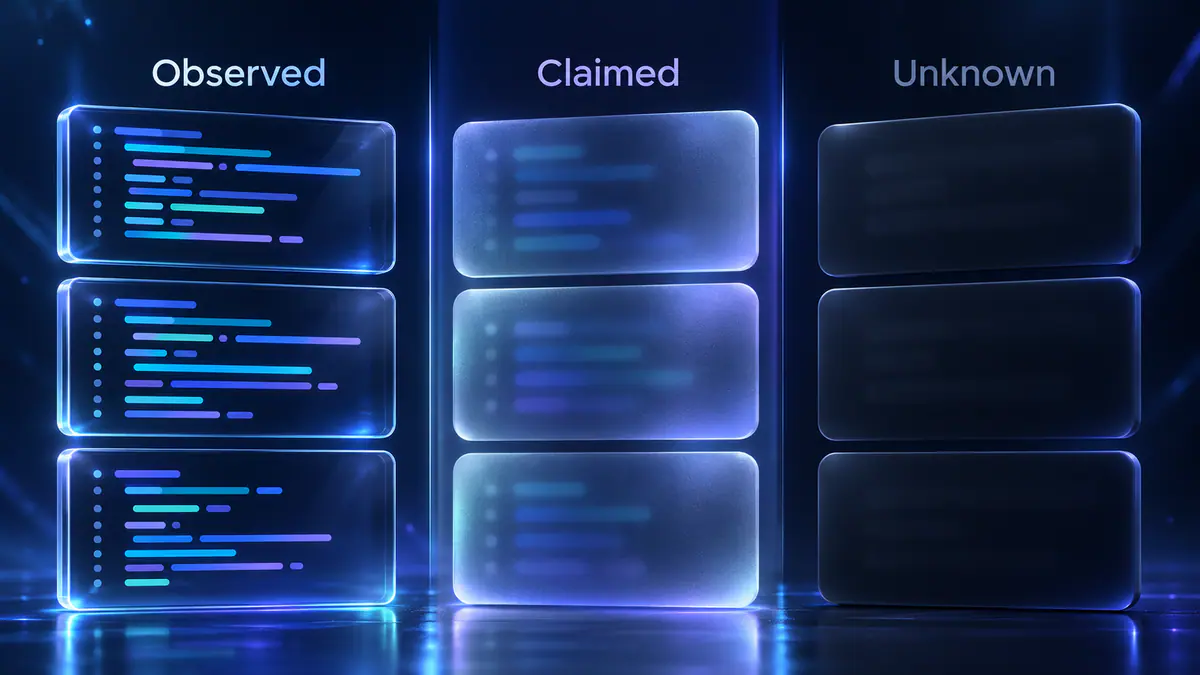
A useful verification record contains the exact listing and source URLs, publisher account, README match, visible history, licence observation, fetch date, HTTP result, and downstream inspection limits. Label developer statements, third-party descriptions, and your own observations clearly. Leave missing evidence explicitly unknown.
For a GitHub-hosted script, record repository and revision details; for a paste or custom host, record the available publisher links and where attribution stops. For protected content, preserve the visible destination and explain that its contents could not be established. Date every conclusion so a later reader knows which version you saw.
Knowing how to verify a Roblox script includes knowing when to leave a question unanswered. If you cannot connect an account to the developer, withhold that attribution. If a claimed update has no matching file change, do not repeat it as confirmed. A useful record makes those gaps visible alongside the facts you could establish.